
From Risk to Resilience - Integrating ESG In Investment Decisions

Executive Summary
This study investigates the funding gap faced by climate-focused companies in Emerging Markets (EM), particularly at the growth stage. It presents a framework for establishing a growth equity fund to address this gap and facilitate the development of scalable climate solutions in EMs.
Why ESG Matters Across the Investment Ecosystem
Family offices, especially locally based or regional ones from emerging markets, often manage wealth that is deeply tied to personal and regional legacies. For these investors, ESG is not merely a compliance checkbox but a way to align their investments to their reputation and values. A leading family office from Singapore – the Tsao Family Office – states that their raison d’etre is ‘Investing to Make Things Better’. They believe that there is never a state of affairs that cannot be improved and, therefore, they strive to create a better social, environmental and financial outcome with their capital. In contexts like India, historically, leading business-owners have focused their philanthropic initiatives on improving the lives of the communities that serve, live around or are impacted by their businesses. However, this is gradually shifting towards a more impact investing approach. A 2025 E&Y report found Indian family offices are moving beyond conventional philanthropy and increasingly directing parts of their investable capital toward initiatives that deliver both financial returns and positive social impact. Businesses in industries such as carpets or textiles have made impact investments to support local artisans and women-led ventures. Going beyond their immediate ecosystem, Rainmatter, the family office of Zerodha’s founders (a leading fin-tech platform), back companies in fintech, climate, health etc and clearly say that they are “patient long-term investors and aren't in it for quick exits”. The EY report also notes that there is a noticeable generational shift in philanthropic interests. Younger members of ultra-high-net-worth Indian families are broadening their focus to include pressing issues like climate change, gender equality, and social injustice, alongside traditional causes such as education and healthcare.
Institutional investors, including pension funds, sovereign wealth funds, and endowments, must balance growth opportunities with the regulatory and systemic risks unique to emerging markets — such as climate vulnerability, governance gaps, and regulatory uncertainty. ESG integration helps institutional investors not only mitigate these risks but also align with the rising global standards demanded by co-investors (especially the multilateral and bi-lateral development finance institutions (DFIs) and regulators.
Several leading institutional investors globally have made clear commitments to integrating ESG considerations into their investment strategies. Norway’s Government Pension Fund Global is a widely recognized ESG leader, actively excluding companies that violate ethical or environmental standards. Pension funds like Philips Pensioenfonds have taken steps to align their emerging market investments with the UN Sustainable Development Goals (SDGs). Major insurance and pension providers such as Aviva, Zurich, Swiss Re, and MAPFREhave committed to aligning their investment and underwriting portfolios with net-zero targets, often exiting high-carbon sectors like coal. Sovereign wealth funds like Singapore’s Temasek and GIC have established dedicated sustainability platforms and funds focused on climate and green infrastructure.
Among the Indian institutional investors as well, there is a growing trend towards adopting ESG principles in their investment strategies. ICICI Prudential Life Insurancewas the first Indian insurer to sign the UN Principles for Responsible Investment (UNPRI) and has launched a dedicated ESG-focused fund. Similarly, Tata AIA offers a Sustainable Equity Fund through its ULIP products, targeting environmentally and socially responsible businesses. The Life Insurance Corporation of India (LIC) has also embedded ESG goals into its operations, claiming contributions to 14 of the 17 UN Sustainable Development Goals (SDGs).
Spanning the ESG integration spectrum, these actions reflect a broader shift among institutional investors toward ESG integration as both a risk management tool and as a value creation tool, including in response to rising stakeholder and regulatory expectations.
For impact funds and investors, who seek intentional and measurable ESG outcomes, ESG integration is part of their very DNA. Applying ESG frameworks helps them track and measure intended outcomes; it also strengthens the impact thesis and facilitates access to blended finance by aligning with the standards of DFIs, philanthropic capital, and other sources of catalytic capital.
Several well-known global impact investment funds have emerged as leaders in combining financial returns with measurable social and environmental impact. Acumen, a pioneer in the space, invests in early-stage enterprises tackling poverty in sectors like healthcare, agriculture, and clean energy across South Asia and Africa. As per its 2025 annual report, under its newly scaled Hardest‑to‑Reachinitiative, Acumen-backed energy companies reached 165,472 people in 2024, of whom 83% accessed electricity for the first time. LeapFrog, which focuses on financial inclusion and healthcare closed its $1bn+ Fund IV in 2024 which aims to serve 100 million emerging consumers and producers to “build better lives” and has already reached 24 million through five initial companies. Blue Orchard, a major impact investor in microfinance and climate reported that the BlueOrchard Microfinance Fund (BOMF) in 2024 reached 52 countries and supported over 900,000 MSMEs in that year alone, with strong gender and rural inclusion: ~77% of end‑borrowers were women, and 66% were from rural areas. ResponsAbility, channels capital into inclusive finance, renewable energy, and sustainable agriculture in developing countries. In 2024, they report having enabled access to financial services for ~50 million people in emerging markets and achieved >1 megatonne CO₂ emissions saved in the preceding year.These funds not only deliver capital to sectors where it is most needed but also prioritize rigorous impact measurement, aligning with global ESG and SDG goals.
In India, the National Investment and Infrastructure Fund (NIIF) states clearly that it seeks to enable responsible growth through sustainable investments. It released its first consolidated ESG and Impact Report 2024, capturing the outcomes of direct investments and indirect investments through NIIF’s portfolio funds. Among other metrics, it reports that 25 M+ tCO2e GHG emissions were avoided, ~1.3 million+ tonnes of solid waste processed, ~340,000 individuals provided with affordable housing due to NIIF investments in FY2024.
Author: Prosperete
Background
Urgent Climate Action needed in Emerging Economies
Climate change poses an existential threat, demanding urgent action. EMs, with their growing populations and rapid development, are crucial players in the global fight against climate change. EMs face a unique set of challenges in addressing climate change.
-
Rapid Development & Population Growth: Rapid economic development and population growth in EM often lead to increased energy consumption and pollution, exacerbating climate change. By 2050, nations currently classified as EMs are projected to house 88% of the global population and their share of global GDP is expected to increase from 50% today to 62%.¹ Estimates suggest 88% of the growth in electricity demand between 2019 and 2040 is expected to come from EMs.²
-
Vulnerability to Climate Impacts: Many EM countries are geographically vulnerable to climate change impacts like rising sea levels, extreme weather events (floods, droughts, heatwaves), and changing weather patterns, threatening food security, infrastructure, and livelihoods.
-
Competing Priorities: Addressing immediate development needs like poverty reduction and infrastructure development can overshadow long-term climate action plans.
-
Limited Resources for Adaptation: EM countries hold immense potential to develop and deploy innovative, low-carbon solutions but often lack the financial resources needed to adapt to and mitigate climate change effectively.
Cleantech 2.0: A Second Chance for Climate Solutions
After the initial struggles of Cleantech 1.0, a renewed interest in climate solutions, termed as Cleantech 2.0, is emerging. This resurgence is fuelled by a transformed landscape. Governments are prioritizing domestic cleantech development, leading to increased investments and the creation of new markets for innovative technologies. Public and private spending in cleantech solutions, particularly in renewables, batteries, and green hydrogen, is also surging, providing crucial capital for start-ups. Additionally, the investor base has diversified, with hedge funds, corporations, and wealthy individuals joining traditional venture capitalists. This broader pool of investors offers more support for ambitious cleantech projects.
However, Cleantech 2.0 still faces challenges. Bridging the "valley of death," the period between proving a technology's viability and generating substantial revenue, requires significant capital. Political and economic shifts can also disrupt progress.
Despite these hurdles, Cleantech 2.0 benefits from a more mature ecosystem and a heightened awareness of past failures. The founders who are active in this sector are second or third time founders with a better understanding of scaling businesses. There is a lot more domestic support for early stage entrepreneurs from government, a growing set of angel investors and early stage venture funds. This improved environment offers optimism for a successful transition to a clean economy, particularly in markets like India. These countries boast large domestic markets, a robust technological base, growing entrepreneurial talent and a strong commitment to sustainability. This unique combination positions them as prime candidates to lead the charge in EM climate tech development.
Opportunity to Replicate Climate Solutions across EMs
EMs are attracting high-caliber founders who are developing innovative solutions. These solutions aim to enhance efficiency, accelerate the adoption of sustainable products, and promote reusability – all with the goal of bolstering the sustainability footprint of economic activities in EMs.
Furthermore, the solutions developed for one EM country often possess adaptability to the realities of other EM countries. This presents a significant opportunity for replicating successful climate solutions across other EM countries, thereby accelerating the global transition towards sustainability.
Several EMs are still in the process of building their infrastructure such as highways, roads, energy access, mobility and affordable housing. All of these provide an opportunity to build green.
India in particular, with its digital prowess, combined with ongoing sustainability initiatives, presents a distinctive opportunity. With a substantial software export base of $320 billion³ and significant technological advancements like Digital Identity and the Unified Payment Interface, India emerges as a natural hub for cutting-edge solutions that can drive sustainability in other EM countries. In other words, the success of sustainability technology ecosystem in select EM countries can help provide a boost to the global climate change agenda.
¹ BCG: The Sustainability Imperative in Emerging Markets
² CEEW: Reach for the Sun
³ DBS Group research report on India’s software exports, April 2023
Key Findings
1. Stakeholder Insights - Climate start-ups struggling with a critical funding gap
In our research, we engaged in-depth discussions with key stakeholders within the climate ecosystem. This diverse group included entrepreneurs, comprising founders and CEOs of climate start-ups, who offered their first-hand perspectives on the challenges of scaling their ventures. Additionally, we consulted investment bankers, well-versed in climate tech investments, who provided valuable insights into the hurdles faced during fundraising efforts. Furthermore, we sought input from policymakers, who offered their perspectives on the value of supporting the broader climate tech landscape.
Through these focused conversations, we gained valuable insights into the specific difficulties faced by start-ups as they endeavour to scale their climate solutions within the context of EMs. This deep dive also provided us with a nuanced understanding of the challenges associated with fundraising for climate tech start-ups. Here are the overarching challenges faced by young climate tech companies in the selected EMs:
Many promising climate start-ups struggle with a critical funding gap, hindering their ability to scale and achieve real-world impact. This "missing middle" challenge arises from several factors:
-
Financing Gap for Scalability: After securing early-stage funding, start-ups often face a dearth of growth capital crucial for scaling their operations. The combination of emerging market risk and climate tech scale up risk contribute to hesitation for larger ticket investments beyond the early stage.
-
Patient Capital Needed: Climate solutions typically require longer investment horizons to mature. This clashes with the shorter timelines favoured by traditional venture capital models.
-
Capital-Intensive Nature: Unlike "capital-light" businesses favoured by VCs, many climate solutions involve building physical assets, demanding significant upfront investment.
-
Limited Market & Consumer Adoption: Lower Total Addressable Markets (TAM) and slow consumer uptake due to cost barriers can make these start-ups less attractive to investors seeking high returns.
-
Impact Measurement Hurdles: Companies struggle to effectively communicate their climate impact due to limited expertise in measuring and communicating environmental benefits.
This combination of factors creates a funding gap that stifles the growth of promising climate solutions. In addition to stakeholder insights, our research, supported by a comprehensive literature review and insights from multiple reputable research platforms, echoes the existence of “Growth Capital” financing gap for climate solution companies operating in EMs.
-
MIT Technology Review highlighted that globally, the pool of funding for the critical "growth stage," crucial for demonstrating first-of-a-kind technologies, remains relatively small.⁴
-
Inc42 also emphasized that the climate start-up funding landscape presents a dichotomy, where early-stage deals continue to flow, however, deals exceeding $50 million are becoming increasingly rare.⁵
-
International Energy Agency (IEA) analysis stressed that outside major hubs like the US and China, most countries lack local investment funds to adequately support their clean energy startups, particularly during the scale-up phase.⁶
2. Mortality rate analysis
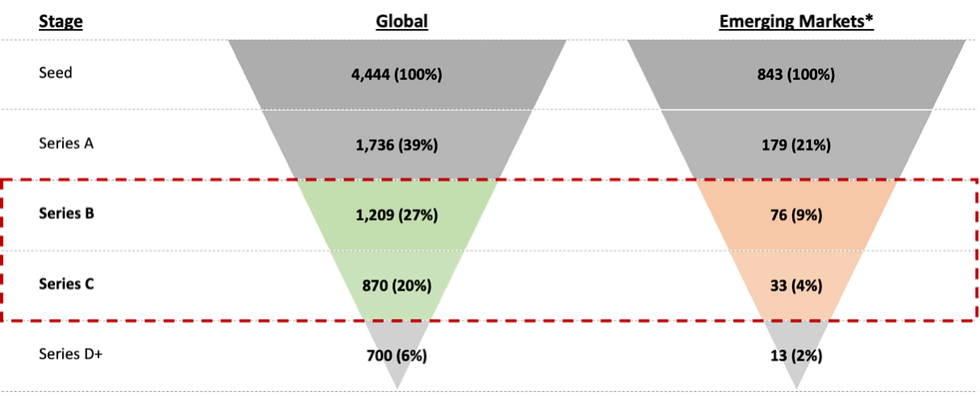
Just 9% of Seed-funded start-ups are reaching Series B
To validate the findings from stakeholder conversations, we conducted a comparative analysis of company mortality rates in the climate sector of emerging markets (EMs) against the global benchmark. Our analysis of 843 companies in selected EM countries revealed that only 9% of climate companies securing seed round funding successfully transition to Series B, whereas at the global level, 27% of seed-funded climate start-ups secure Series B funding. Similar trend was also observed at Series C, where only 4% of Seed-funded climate companies in EM progressed to Series D against the global benchmark of 20%. It exposes a concerning disparity: EM climate companies have a threefold lower chance of progressing beyond the growth stage compared to the global average. This significantly hinders their ability to scale and contribute to climate goals.
Climate Start-ups Mortality Rate Analysis through Funding Funnel
Source: Tracxn, Prosperete research; *Selected EMs include Bangladesh India, Indonesia, Nigeria, and South Africa
Summary: Our comparative analysis of 843 companies in climate sectors in EMs shows that only 9% successfully transition to Series B after seed funding, contrasting with the global rate of 27%. This underscores market insights that numerous promising climate start-ups struggle with a critical funding gap, impeding their ability to scale and often leading to early closure.
3. Quantification of Funding Gap - $5.2 Billion Growth Capital Gap
We scrutinized over 1,697 investment deals in climate solutions spanning from 2017 to 2022. In our analysis, we classified fundraising from Seed to Series A rounds as Early stage, Series B to C rounds as Growth stage, and Series D round onwards as Late stage investments. Our findings reveal that in countries such as India investment in the Growth stage slightly surpassed Early stage funding but fell short of meeting the demands for scaling, underscoring the need for increased support at this critical stage of development.
Stage-wise Funding Climate Solution Companies, in $ million
Stage-wise Funding Climate Solution Companies, in $ million

Source: Tracxn; Prosperete research
To quantify the underinvestment gap, we estimated the total investment needed for EM countries to align with the levels observed in developed markets. By comparing the total capital invested in the EM climate market to the estimated total investment required to reach US market funding levels, we could quantify the potential funding gap. This gap represents the additional capital needed for EM climate tech companies to achieve similar growth trajectories as their developed market counterparts. Based on climate investments in the US from 2017 to 2022, totalling $122 billion⁷, we determined the climate investment need to be 0.5% of Nominal GDP ($25.5 trillion).⁸
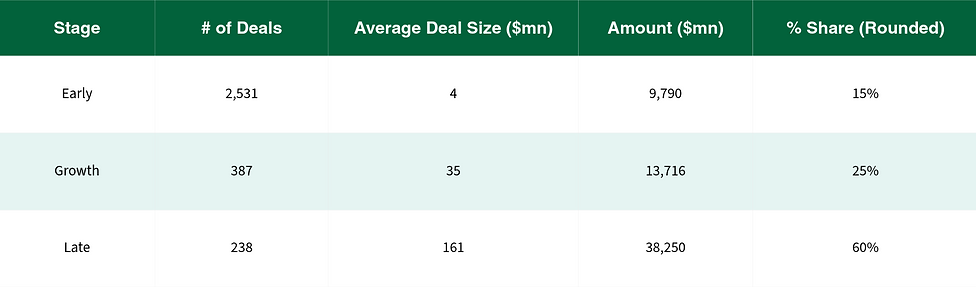
This total investment need was then segmented into early, growth, and late-stage rounds. We estimated the average stage-wise venture capital (VC) funding requirement share for companies based on an analysis conducted by Bain & Co. of 3,156 VC deals in India spanning the period from 2021 to 2022. According to our internal assessment, scaling a company typically necessitates 15% of funds at the early stage, 25% at the growth stage, and 60% at late-stage rounds.
Stage-wise Funding Need Share (%)
Source: Bain & Co., Prosperete research
The financing gap was computed as the growth stage investment required to meet the current standard observed in developed markets, less the actual investment in climate solutions during the 2017-2022 period. The data reveals a concerning funding gap across all stages, with the most acute shortage at the growth stage (Series B to D). Our analysis suggest a total growth stage financing gap of $2 billion in India.
Financing Gap at Growth Stage Climate Companies

Source: Tracxn, World Bank, Prosperete research
4. Landscape Analysis – Clear “Growth Stage” Whitespace in the Market
Our analysis of the VC and PE landscape revealed a critical gap – existing funds are not allocating sufficient resources to the growth stage of companies in climate sectors in EMs. This presents a significant opportunity for new funds with a specific focus on climate solutions. Research identified a clear "white space" in climate-focused growth stage funds. While we found over 35 early-stage and 11 late-stage sustainable and climate-dedicated funds, only four targeted the crucial growth stage. This aligns with findings from our other approaches, all highlighting the urgent need for additional growth capital to support the scaling of climate solutions in emerging markets.
Addressing the funding gap is key to a vibrant climate ecosystem in EMs. Our analysis suggests establishing 4-5 new growth-stage funds, each averaging $300 million, in India itself.
Summary: Our analysis revealed a $2 billion capital gap at the growth stage in India, signifying the additional growth capital needed for climate companies to align with the growth trajectories of their counterparts in developed markets. This scarcity of growth capital emerges as a common challenge across the climate ecosystems.
Summary: Our analysis unveils a critical gap in equity funding for growth-stage companies in the climate sector in India (only 3 vs 30+ early-stage), presenting an opportunity for new funds specialized in climate solutions. This underscores the urgent need for additional growth capital to support scaling, advocating for the establishment of multiple new growth-stage funds across these countries to foster a vibrant climate ecosystem.
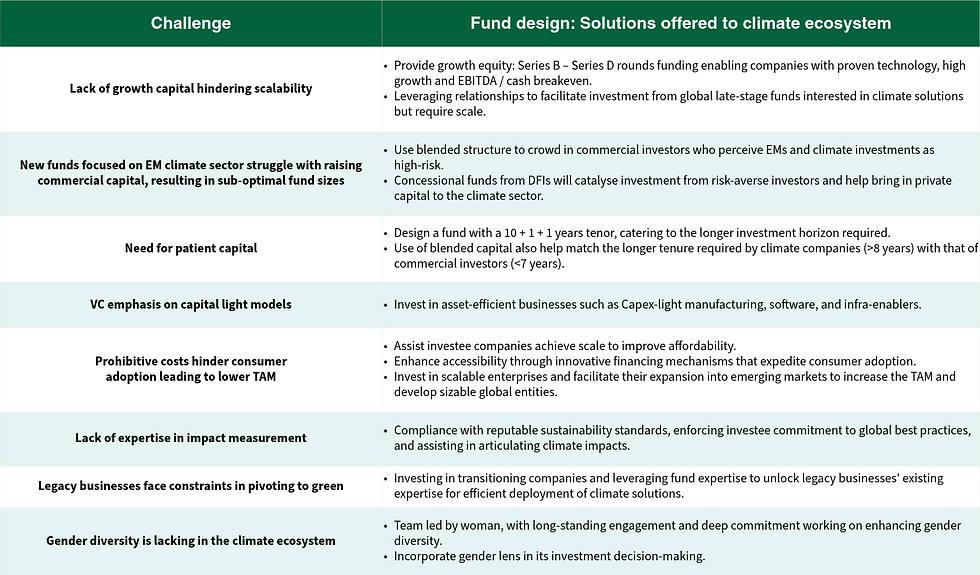
5. Fund Design and Investment Strategy
To unlock the potential of climate-focused companies, this note identifies the key features for a successful growth stage strategy. Drawing insights from in-depth discussions key stakeholders in the climate ecosystem, we pinpointed key challenges and formulated a fund designed to effectively address them.
⁴ MIT Technology Review - Climate tech is back and this time, it can’t afford to fail, December 2023
⁵ Inc42 - Venture Capital Trends In India In 2023 And The Outlook For 2024, December 2023
⁶ IEA - World Energy Investment 2022
⁷ VC investment in climate tech sourced from Dealroom.Co
⁸ Nominal GDP of the US for 2022 sourced from World Meter.
Conclusion
A clear bottleneck hindering growth
Our implementation of a multi-pronged approach has unveiled a critical bottleneck - the lack of growth capital is hindering the growth of climate start-ups in emerging markets. Our research reveals a stark disparity: only 9% of seed-funded companies in climate sectors progress to the growth stage, a mere third of the global average (27%).
The stakes are high
This translates to 625+ of promising companies which secured seed funding during 2017-2022 period, currently stagnating, with potentially thousands more facing the same fate in coming years, all due to a lack of growth capital. This situation jeopardizes the development of a vibrant climate ecosystem in emerging markets and hinders our collective ability to achieve climate goals.
Existing early-stage funds are vulnerable too
Even early-stage funds, which have invested over $2.0 billion in companies in the climate space between 2017 and 2022, face vulnerability. This arises because these investments heavily depend on the availability of growth-stage capital to ensure successful exits for their portfolio companies.
The time to act is now
With emerging markets experiencing significantly higher GDP growth (projected 10.0% nominal GDP growth rate), the climate funding gap is expected to be around $8.0-10.0 billion in the next five years, compared to the $5.2 billion deficit of the last five. This and the severe impacts of climate change in Emerging Markets, necessitates the urgent creation of new growth capital funds specifically designed to provide growth capital to climate solutions in emerging markets.
Proposed solution - tailored growth capital fund
We propose the establishment of multiple new growth-stage funds specifically designed to address the needs of EM climate start-ups. These funds can play a pivotal role in fostering a vibrant climate ecosystem in EMs, ultimately contributing to a more sustainable future for our planet.
Research Methodology
The study investigates the key roadblocks hindering the scalability of climate solutions developed by young start-ups in EMs with a focus to India. We employ a multi-pronged research approach to analyse the factors limiting growth within the climate tech sector of these regions.
-
Stakeholder Insights: Conversations with Climate Ecosystem Leaders:
To gather qualitative data and gain a deeper understanding of the challenges faced by young climate tech startups in EMs, we conducted in-depth conversations with over 120 key stakeholders within the climate ecosystem. This diverse group included entrepreneurs, investment bankers, and other influential individuals actively involved in climate-related initiatives. Through these conversations, we aimed to gain valuable insights into the challenges faced by companies as they attempt to scale their solutions and navigate the complexities of fundraising within the climate tech space.
-
Comparative Analysis of Start-up Mortality Rate in Climate Sector:
To corroborate the findings from interviews with climate ecosystem leaders, we conducted a comprehensive analysis of 843 climate companies which raised capital during 2017 – 2022 period, in the selected EMs between 2017 and 2022, focusing specifically on companies offering climate solutions. We examined company mortality trends across different stages of company development. By comparing these trends to the global benchmark, such as global data from a well-recognized investment database, we aimed to identify any potential discrepancies in the funding funnel specific to EM climate tech companies.
-
Quantification of Funding Gap:
To assess the disparity in funding available to start-ups in the climate sector in EMs compared to developed markets, we analysed 1,697 funding deals data to estimate capital funding allocated to such companies within the selected EMs during the period 2017-2022. Additionally, we utilized data on climate investments in the US market during the same period as a benchmark representing developed markets. The US market serves as a reference point due to its established climate ecosystem. By comparing the total capital invested in the EM climate market to the estimated total investment required to reach US market funding levels, we were able to quantify the potential funding gap.
-
Landscape Analysis of VC and PE Funds:
To gain a comprehensive understanding of the current funding environment for climate start-ups in the selected EMs, we conducted a comprehensive analysis of the VC and PE landscape. This analysis involved mapping the activities of over 80 VC and PE funds operating within these regions. Our focus was on examining the investment focus areas to identify potential gaps in the market and areas requiring additional resources for robust growth in climate solutions.
Summary: Our research, which involved interviews with climate entrepreneurs, investors, and policymakers, revealed a fundamental challenge facing young climate start-ups in emerging markets: a funding gap. The absence of growth capital poses a significant risk to early-stage investments, threatening the ability of investee companies to scale effectively. This critical gap, often referred to as the "missing middle," is evident in the higher mortality rate of early-stage companies. Confirming this finding, research from MIT Technology Review, Inc42, and the IEA underscores the global scarcity of "growth capital" for climate start-ups, particularly in emerging markets.